A garage, shed, or utility slab is a different job than a driveway or patio: usually no vehicle traffic beyond parking, often enclosed, and the base prep underneath it does more of the work than the finish on top. In Oklahoma City, that base prep is also the single step most likely to determine whether the slab holds up against the clay underneath it.
What it costs
A plain concrete slab, installed, runs roughly $4 to $12 per square foot for straightforward flatwork, the same general range as a patio, since a garage or utility slab is comparable flatwork without a decorative finish added on top. What moves the number: square footage, thickness, reinforcement (mesh vs. rebar), and, on Oklahoma City's clay, the base and subgrade prep, which is a bigger line item here than it would be on a low-clay market.
Thickness and reinforcement
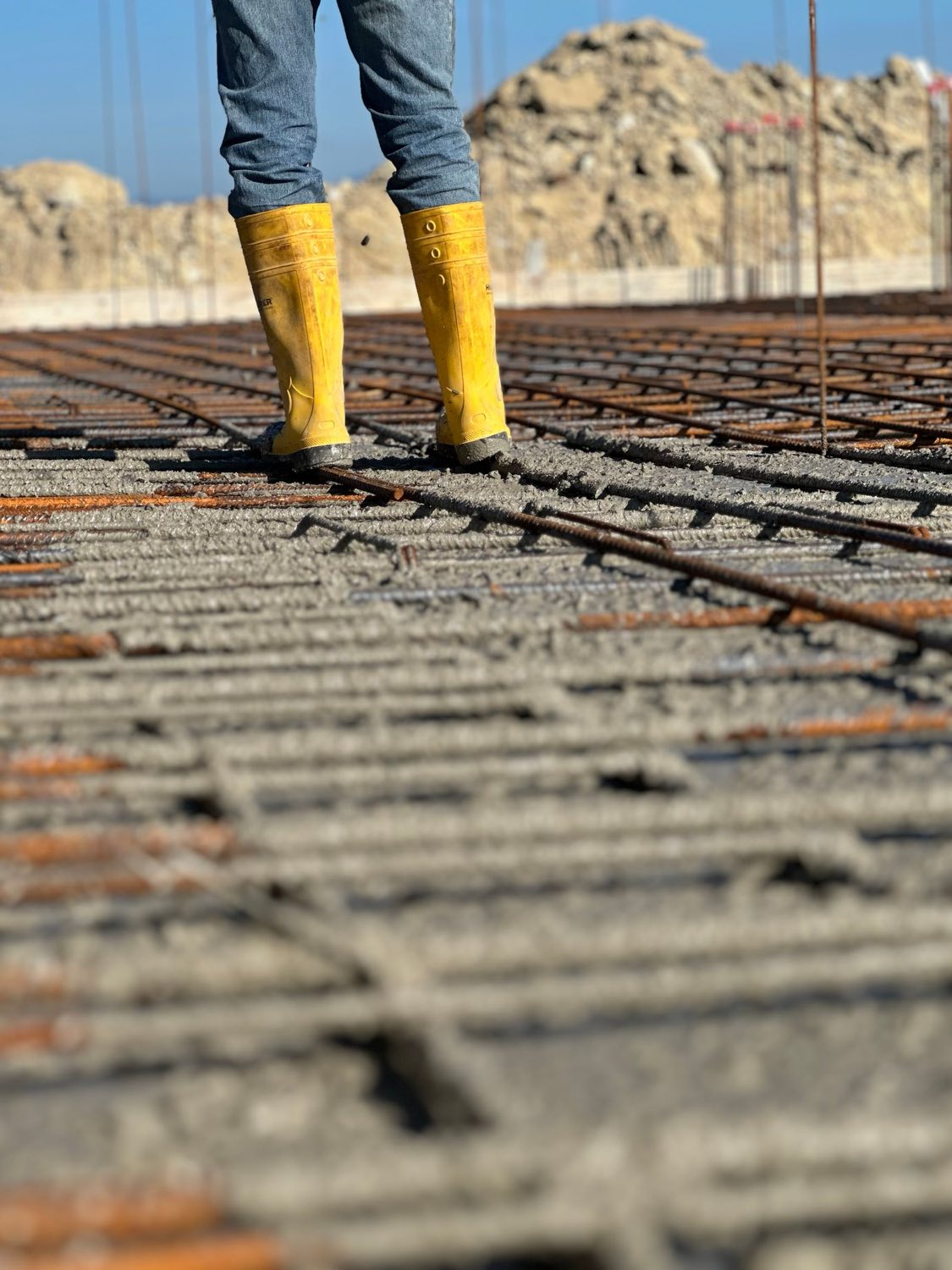
A residential slab-on-grade (garage, shed, or utility pad) is typically specified in the same general thickness range as other residential flatwork, with reinforcement chosen by expected load. Welded wire mesh (commonly 6×6 W2.9) distributes and controls general shrinkage cracking without adding structural strength; it's the common, lower-cost choice for a garage or shed slab under normal loads. Rebar (commonly #3 bar at 18 inches on center) is the heavier option where the slab needs to carry more than typical light loads.
Why base prep is the step that decides whether a slab holds up here
This is the detail that matters more for a slab than any other line item in the job, because a slab-on-grade has no other structural system underneath it. It's poured directly on prepared ground, and that ground is doing real work.
Oklahoma City's residential subgrade is dominated by Kirkland, Renfrow, and Renthin soils, vertic-intergrade prairie clays formed on Permian red beds. Measured soil surveys put these soils at 40 to 60 percent clay, with shrink-swell ratings (linear extensibility) as high as 17 at the highest points measured, and the Renfrow soil series description documents slickensided horizons with cracks 5 millimeters or wider running through 30 centimeters of soil. That's a soil built to change volume with moisture, swelling when it's wet and shrinking when it's dry. Because moisture is never uniform across a slab's footprint, the movement underneath is differential rather than even. A slab poured directly onto that clay without correcting for it will telegraph the soil's movement back through as cracking, heaving in spots, and faulted control joints.
The standard counter-move, and the one that actually determines whether a garage or shed slab lasts on this subgrade:
- Compact the subgrade to roughly 95 percent standard Proctor density, per ASTM D698, the standard reference for compaction testing, commonly cited in DOT specifications.
- Place a compacted crushed-stone base over the compacted subgrade, typically 4 to 6 inches of open-graded #57 stone per AASHTO M43 gradation. This base layer separates the slab from the clay's active shrink-swell zone and gives water somewhere to drain instead of pooling and saturating the soil directly under the concrete.
- The #57 stone is placed and compacted to a stable, choked-in condition rather than tested to a Proctor percentage. It's open-graded stone, not soil, so the compaction standard that applies to the subgrade doesn't apply the same way to the base course above it.
Skipping or shortcutting this step is the single most common way a budget slab quote turns into a redo. A slab that looks identical to a properly prepped one on the day it's poured can start cracking and heaving within a season or two if the clay underneath was never separated from it.
Control joints
Even with correct base prep, a slab still needs joints to control where its own shrinkage cracks form. ACI guidance recommends a maximum control-joint spacing of 24 to 36 times the slab thickness, with saw-cut depth at least a quarter of the slab thickness and panels kept to a length-to-width ratio of 1.5:1 or tighter. For a garage or shed slab, that typically means dividing the pour into a small number of roughly square panels rather than leaving it as one large uncontrolled area. Full detail on the spacing rule is on the concrete driveways page, where the same rule applies at driveway scale.
Questions people ask
Does my garage slab need the same base prep as a driveway? Yes. The clay underneath doesn't know the difference between a driveway and a garage slab. Both sit on the same subgrade, and both need the compacted subgrade and stone base to keep the clay's movement from telegraphing through the concrete. The load a driveway carries is different; the ground underneath it is not.
Why did my slab crack within a year or two when the contractor said it was a quality pour? The finish and the pour can be done well and the slab can still crack if the base prep underneath was skipped or shortcut. On Oklahoma City's high-clay subgrade, an unprepared or poorly compacted base is the most common reason a newer slab starts showing cracking or heaving faster than expected.
Is a shed slab worth the same base prep as a garage? The stakes are lower on a shed, but the mechanism is the same: any slab poured directly on this clay without a compacted subgrade and stone base is exposed to the same differential movement. For a small utility slab the base-prep cost is a smaller absolute number, which makes it a comparatively easy line item to include rather than skip.
Area covered
Oklahoma City, Edmond, Moore, Norman, Midwest City, Del City, The Village, Nichols Hills, Yukon, Bethany, Warr Acres, Choctaw, and Harrah.