A driveway is the highest-ticket concrete flatwork job on a residential property, and in Oklahoma City it's also the flatwork most exposed to both of the local damage drivers at once: the clay subgrade underneath it and the freeze-thaw cycling on its surface every winter. Both shape what a driveway costs, how thick and how strong it should be built here, and the base prep that keeps it from telegraphing the clay's movement back through fresh concrete.
What it costs
A plain concrete driveway typically runs $8 to $18 per square foot to install (about $6,000 for a standard two-car drive), and driveway repair averages around $1,812, with a typical range of $830 to $2,838. These are typical national ranges, not a quote for a specific driveway; the real number depends on square footage, thickness, reinforcement, base prep, finish, and site access.
Why the strength spec is different here than on a no-freeze coast
This is the detail that changes the mix design, and it's the clearest place where an Oklahoma City driveway diverges from one built on the Gulf Coast. Residential flatwork is commonly specified at 3,000 to 4,000 psi. In a mild, no-freeze climate, 3,000 to 3,500 psi is a common minimum. But where the slab sees freeze-thaw cycling and deicing salts, ACI 318 §19.3 requires a 4,000-psi minimum with air entrainment (roughly 4.5 to 7.5 percent air) for freeze-thaw exposure. Oklahoma City averages about 72 nights a year at or below freezing, with meaningful year-to-year swing (the 30-year range runs 53 to 93 nights). That's squarely inside the freeze-thaw exposure condition the code is written for, so a driveway poured here should be specified to that 4,000-psi, air-entrained standard, not the mild-climate minimum. This is a climate-conditional requirement: it isn't optional upsell language, and it isn't something a warm-climate market would need to spec at all.
Air entrainment matters mechanically, not just as a code checkbox. Water sitting in the concrete's pores and on a saturated slab surface freezes and expands roughly 9 percent in volume with every hard freeze; entrained air gives that expanding water somewhere to go inside the paste instead of pushing the surface apart. Skip it on a driveway that sees OKC's roughly 72 freeze nights a year and the surface is set up for the scaling and spalling covered in more detail on the freeze-thaw, scaling & spalling page.
Thickness
ACI 330R is the design manual for parking lots and the standard reference for residential driveway thickness. It recommends a minimum 4 inches for a typical residential driveway, increasing to 5 to 6 inches where winter freeze-thaw or heavier vehicles apply. Given OKC's freeze-thaw exposure, the thicker end of that range is the more defensible spec for a driveway here, not the bare 4-inch minimum a warm-climate driveway might use. A driveway apron that crosses the public right-of-way is frequently required to be even thicker, often 6 to 8 inches with continuous rebar, under the local municipality's rules, separate from the building code; that requirement is jurisdiction-specific and should be confirmed with the relevant public-works department before a bid assumes it.
What the clay subgrade requires before the pour
The other half of a driveway that holds up in Oklahoma City happens before any concrete is placed. OKC's residential subgrade is dominated by Kirkland, Renfrow, and Renthin soils: vertic-intergrade prairie clays measured at 40 to 60 percent clay, with shrink-swell ratings (linear extensibility) as high as 17 at the highest points measured, and slickensided horizons with cracks 5 millimeters or wider running through 30 centimeters of soil, per the Renfrow soil series description. That clay swells wet and shrinks dry, and because moisture is never even across a driveway's footprint (drought at an exposed edge, runoff pooling at another), the movement underneath is differential. Cast flatwork directly on that clay without correcting for it, and the slab telegraphs the soil's movement back through as cracking, panel heave, and faulted joints.
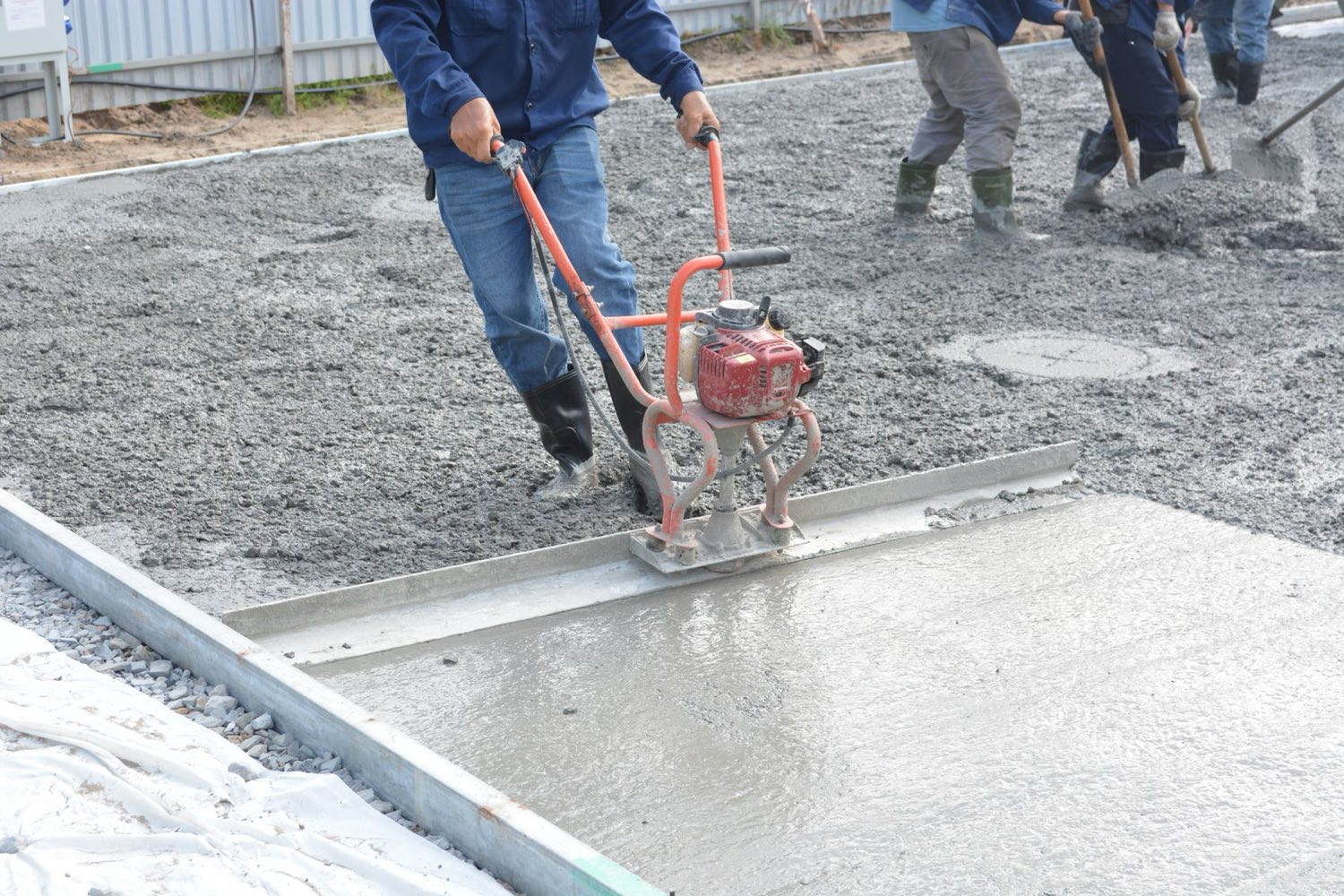
The standard counter-move: compact the subgrade to roughly 95 percent standard Proctor density (ASTM D698), then place a compacted crushed-stone base, typically 4 to 6 inches of open-graded #57 stone (AASHTO M43 gradation), which separates the slab from the active shrink-swell layer and gives water somewhere to drain instead of pooling under the concrete. The #57 base is placed and compacted to a stable condition rather than tested to a Proctor percentage, since it's open-graded stone, not soil.
Joint spacing
Control joints exist to pre-decide where the slab's inevitable shrinkage crack goes, rather than letting it crack randomly. ACI guidance recommends a maximum control-joint spacing of 24 to 36 times the slab thickness: 24× under high-shrinkage conditions like hot, dry, windy placement, 36× in more controlled conditions. That works out to joints roughly every 8 to 12 feet on a 4-inch driveway and roughly every 12 to 18 feet on a 6-inch one. Two companion rules: saw-cut depth should be at least a quarter of the slab thickness, and panels should be kept to a length-to-width ratio of 1.5:1 or tighter to avoid long, crack-prone strips. Driveways specifically tend toward the tight end of that range, around 8 to 10 feet, because they're exposed to thermal cycling on every side.
Reinforcement
Welded wire mesh (commonly 6×6 W2.9) distributes and controls general shrinkage cracking across a driveway slab but doesn't add structural strength. Rebar (commonly #3 bar at 18 inches on center) is the heavier option for driveways carrying regular vehicle load, especially on thicker pours or right-of-way aprons. Fiber mesh, mixed into the concrete, reduces plastic-shrinkage cracking in the first 24 hours but supplements rather than replaces connected steel. The practical consensus: mesh for general residential crack control, rebar where the load or apron requirement calls for it, fiber as a supplement.
Finishes
Broom finish, textured for slip resistance, is the default for driveways. Stamped and decorative finishes are more common on patios than driveways and are frequently prohibited outright in the public right-of-way portion of a driveway apron, which is a separate reason to keep decorative work off the apron section even where it's allowed on the rest of the drive.
What moves the cost
Square footage, thickness (4 vs. 5–6 inches for freeze-thaw exposure), reinforcement choice, base and subgrade prep (a bigger line item on OKC's high-clay soil than on a low-clay market), finish, demo and haul-off of an existing driveway, site access, and any right-of-way apron requirements.
Questions people ask
Does a driveway in Oklahoma City really need the freeze-thaw concrete spec, or is that overkill? It's the code-required minimum for the exposure. ACI 318 §19.3 sets a 4,000-psi, air-entrained minimum specifically for freeze-thaw and deicer exposure, and OKC's roughly 72 freeze nights a year put a driveway here squarely in that exposure category. A warm-climate market that never sees hard freezes doesn't need to meet that spec; a driveway built here without it is under-specified for the winters it will actually see.
Why does base prep matter more here than in some other markets? Because OKC's dominant residential subgrade is a high-clay, high-shrink-swell soil. Skipping proper subgrade compaction and a stone base lets the clay's seasonal swelling and shrinking move unevenly under the slab, which is what cracks and heaves driveways on this soil specifically.
How long before a new driveway can handle vehicle traffic? Concrete reaches roughly 75 percent of its 28-day design strength by day 7. Practical use windows, temperature-dependent: walkable in 24 to 48 hours, light-vehicle driving around 7 days, with driveways commonly held to about 14 days before regular use, and full structural load capacity around 28 days.
Area covered
Oklahoma City, Edmond, Moore, Norman, Midwest City, Del City, The Village, Nichols Hills, Yukon, Bethany, Warr Acres, Choctaw, and Harrah.